CANCERSCAPE Session to Demystify Site-Neutral Payment Policy
By Amanda Patton, ACCC Communications
 In recent months MedPAC, the Centers for Medicare & Medicaid Services (CMS), Congress, and the GAO have ramped up attention on the impact of consolidation and integration, shifts in sites of service, and how unequal payment rates across settings of care are affecting Medicare costs.
Adding to the controversy (and confusion) around site-neutral payment as a solution to reducing the Medicare “spend” is the recently passed Bipartisan Budget Act of 2015 at Section 603, “Treatment of Off-Campus Outpatient Departments of a Provider.”
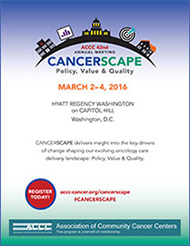
Although the issues surrounding site neutral payment policy are complex, “Section 603 is pretty straight forward,” says Ronald Barkley, MS, JD, of the CCBD Group. “It’s the downstream unintended consequences that cancer programs need to understand.” In a session at the upcoming ACCC Annual National meeting in Washington, D.C., March 2-4, Barkley will demystify site neutral payment policies, lay out pros and cons, and provide a realistic assessment of the potential impact of Section 603. Attendees will leave with a 360-degree understanding of the issues and a “knowledge base to work from” going forward, Barkley said.
Site-neutral payment policies have the potential to affect revenue and budgeting, strategic planning, pro forma development, and 340B Drug Program participation. Thus, a thorough understanding of Section 603 is critical for today’s cancer program leadership.
Time is of the essence, according to Barkley. “There is a window of opportunity to take your message to CMS before [the agency] translates the [Section 603] legislation into regulation.”
Attend the ACCC 42nd Annual Meeting, CANCERSCAPE, from March 2—4, 2016, in Washington, D.C., and gain strategic insight into key drivers of change impacting our evolving oncology care delivery system in sessions focused on Policy, Value, and Quality. Learn more here. Want to discuss this issue with your elected representatives on Capitol Hill? See what’s planned for ACCC Capitol Hill Day on March 2.
Why ICD-10 Codes Must Tell Your Patient’s Story
 By Amanda Patton, ACCC Communications
We’re four months post ICD-10 implementation and some are comparing the transition to Y2K—a lot of sound and fury over what ultimately turned out to be a relatively calm transition.
If you think it’s all smooth sailing from here on out, think again. “ICD-10 is nothing like Y2K,” says Cindy Parman, CPC, CPC-H, RCC, Principal, Coding Strategies, Inc. “Moving to ICD-10 is more like having a baby. Once the baby’s arrived the work begins.”
In a session on Friday, March 4 at the ACCC 42nd Annual Meeting, CANCERSCAPE, Parman will be sharing tips for cancer programs to take stock of their ICD-10 transition.
Post implementation, what ICD-10 pain points is Parman seeing in oncology programs?
· Coding errors. These may be coder mistakes or they may stem from insufficient documentation in the medical record—for example, physicians not providing enough information.
· Productivity. Working with ICD-10 is taking coders longer because there is more information to sift through and coders may have to go back to physicians with questions.
· Reimbursement issues. Insurance payers are taking an opportunity to tighten up qualifications for reimbursement. Some ICD-9 codes may have been reimbursed in the past, where the corresponding ICD-10 code will not result in payment. Even smooth transitions to ICD-10 don’t necessarily mean that cancer programs are coding correctly, Parman warns.
“It’s important for cancer programs to understand that ICD-10 is a patient classification system,” says Parman. Used appropriately, the code set will generate the data that tells the patient’s story and ensure that providers are getting credit for all of the care that is being provided. But when codes are missed that story is incomplete.
New payment models will be driven by ICD-10 codes, and capturing all the care provided for patients is critical, Parman says. “The data that cancer programs are collecting today will be used by the Centers for Medicare & Medicaid Services (CMS) to develop future alternative payment models (APMs). If the codes used do not reflect the full scope of services provided, cancer programs won’t be able to go back later and say ‘we left these codes off.’ ”
During her meeting session, Parman will discuss the potential for mining ICD-10 data to measure quality, safety and efficiency, among other indicators. But, she points out, “You can’t mine data you don’t have.”
Join us at the ACCC 42nd Annual Meeting, CANCERSCAPE, from March 2—4, 2016, in Washington, D.C., and gain strategic insight into three key drivers of change impacting our evolving oncology care delivery system: policy, value, and quality. Full session and speaker information available here.
Required Reading: “Advancing Immuno-Oncology in the Community Setting”
 By Lee Schwartzberg, MD, FACP
Chair, Institute for Clinical Immuno-Oncology, Advisory Committee
Along with their copies copy of the January/February Oncology Issues, ACCC members will receive “Advancing Immuno-Oncology in the Community Setting,” the inaugural white paper from the Institute for Clinical Immuno-Oncology (ICLIO), an institute of the Association of Community Cancer Centers (ACCC).
As members of the oncology community well know, the last five years have brought us thrilling advances in immunotherapy. We’ve seen the introduction of checkpoint inhibitors and vaccines that are unleashing the power of an individual’s immune system to fight cancer. In the past few months, we’ve witnessed a surge of new FDA indications for immunotherapy agents in a number of disease sites, including melanoma, lung cancer, and renal cell carcinoma.
Immuno-oncology is now emerging as the fourth pillar of cancer treatment. It is a new field, bringing new promise and new challenges for patients, providers, and payers.
As Chair of the ICLIO Advisory Committee, I urge you to take a few minutes to explore the ICLIO white paper. Whatever your role in cancer care delivery, you’ll benefit from learning about the resources ICLIO offers today and those planned for tomorrow. Here are three reasons to learn about ICLIO:
- The immunotherapy momentum continues to build. There is a robust pipeline of new immunotherapies in development, as well as emerging combination therapies. Staying up-to-date on advances in this new field is imperative—for your cancer program and your patients.
- Empowered, informed patients and their families will be asking about (and for) these new immunotherapy options.
- The challenges of integrating new therapies occur on many fronts—clinical, administrative, programmatic—and across disciplines. ICLIO brings a multidisciplinary approach to addressing these challenges with practical resources that help build a bridge from bench to bedside so that eligible patients in the community can access these new therapies and receive care in an evidence-based way.
For more, explore ICLIO resources online at accc-iclio.org and learn about future ICLIO initiatives. Take advantage of our upcoming ICLIO webinars in January:
Immunotherapies for the Treatment of Metastatic Renal Cell Carcinoma (mRCC)
January 15, 2016
12 pm, ET
Navigating Patient Assistance Programs for Immunotherapy Treatment
January 21, 2106
12 pm, ET
Coordination of Care for Immunotherapy Patient
January 27, 2016
12:30 pm, ET
Learn more and register for the webinars here. Join our community centered on transformative care!
ACCC Advocacy Update
By Leah Ralph, Director, Health Policy, ACCC
 Congress closed out 2015 with a bang, passing a number of large, end-of-year spending bills to keep the government funded through 2016 and several provisions that will impact ACCC members.
The omnibus appropriations bill (H.R. 2029) boosted NIH funding by 6.6 percent to $32.1 billion, the largest increase NIH has seen in 12 years. A separate package of Medicare provisions, the Patient Access and Medicare Protection Act (S. 2425) passed just before Congress adjourned for the year. This legislation created a blanket hardship exemption for meaningful use penalties in 2015, making it easier for the Centers for Medicare & Medicaid Services (CMS) to review and process hardship exemption requests. (To apply for an exemption, physicians must apply by March 15, 2016, and hospitals by April 1, 2016.)
The Medicare bill also froze payment rates to freestanding radiation therapy centers at 2016 levels for two years, CY2017 and CY2018. It is important to note that the Medicare bill ultimately did not include a provision that would have exempted “under construction” off-campus outpatient facilities from an earlier law (the Bipartisan Budget Act of 2015) that reduced Medicare payments to newly built or acquired hospital outpatient departments.
Before year-end President Obama signed both H.R. 2029 and S. 2425 into law.
As attention shifts toward elections in 2016, with divergent views on the future course of the nation’s healthcare policies, we are sure to see even more movement on policies that will impact the provision of quality cancer care. Make your New Year’s resolution today to join us for ACCC Capitol Hill Day March 2, 2016. Learn more and register here.
An Easy—and Empowering—New Year’s Resolution
By Leah Ralph, Director, Health Policy, ACCC
 New Year’s resolutions are the very definition of trope: a common or overused theme. But they don’t have to be. Today I’m asking you to set aside the old standbys of weight loss or more exercise and look at the bigger picture—specifically what you can do to improve the lives of the cancer patients you treat each and every day.
Last year ACCC mobilized members from 23 states and held over 80 meetings with legislators on Capitol Hill about issues of importance to the oncology community. We effected real change. Shortly after our ACCC Hill Day visits, Congress passed a permanent repeal to the Sustainable Growth Rate (SGR) formula, guaranteeing predictable physician payment rates and setting in motion a wave of Medicare reimbursement reforms. Our voices made a difference!
This year, we’re growing our annual Capitol Hill Day program and making some exciting changes: more comprehensive training, more face time with legislators, and, most important a greater focus on helping you tell your community’s story—the one that your legislators most want to hear. What’s going on in your home town? What’s keeping you up at night? What are the stressors that are having a negative impact on your cancer patients?
So whether you’ve attended a previous ACCC Capitol Hill Day or you’re an “advocacy newbie,” here are three solid reasons to make the ACCC 2016 Capitol Hill Day your New Year’s Resolution:
- More comprehensive training. The ACCC policy team will host webinars and conference calls to prepare for your congressional meetings. We’re planning a comprehensive training and reception for Tuesday, March 1, plus an additional advocacy review on the morning of Hill Day, Wednesday, March 2.
- More face-time with legislators. Gather for lunch with your ACCC colleagues and congressional members to discuss key issues that impact your program, such as reimbursement for supportive care services, drug costs, staffing shortages, and how excessive data collection and reporting is cutting into the time you can spend on direct patient care.
- Less focus on specific bill numbers. You don’t need to be a “policy expert” or familiar with specific legislation in 2016. It’s a chance to share YOUR STORY so lawmakers understand how policy impacts oncology care in YOUR COMMUNITY. (Now, if you want bill numbers, we’ll have those too.)
Policymakers rely on healthcare providers—not policy staff—to provide real-world perspectives on policy issues that matter. As the leading national multi-site, multidisciplinary organization, ACCC is uniquely positioned to serve as a resource. This is our value to legislators. The diversity and sophistication of our membership requires a nuanced, balanced approach to policy challenges—and we stand ready to offer insights on how cancer care is delivered today.
As our experts, we invite you to come to Washington, D.C., to do what you do best. Talk about your programs, your processes, and most importantly your patients. Our annual Capitol Hill day is an important and rewarding opportunity to advocate for policy change. Resolve to attend ACCC Capitol Hill Day 2016, and help to put the voice of the cancer care team and cancer patient at the center of policy decisions. Learn more at accc-cancer.org/HillDay.
ACCC Comments on Proposed 340B Guidance
 By Maureen Leddy, JD, Manager, Policy and Strategic Alliances, ACCC
On October 27, 2015, the Association of Community Cancer Centers (ACCC) submitted comments on the Health Resources and Services Administration (HRSA) “mega-guidance” on the 340B Drug Pricing Program. ACCC supports HRSA’s effort to provide more clarity in the program and we commend HRSA for taking this important step amid legal challenges and Congressional pressure. But just how far the guidance will go remains unclear. While HRSA’s guidance does not have the strength of a rulemaking, it does inform 340B participants how the agency believes the program should operate, and we can expect it will be used as a basis for future audits. It remains to be seen whether Congress will codify the guidance or move any other legislation related to 340B.
HRSA’s guidance largely focuses on laying out a narrower definition of a patient under the program. Essentially the guidance proposes to significantly strengthen the relationship between the 340B covered entity (CE) and patient in order for that patient to qualify for 340B discounted drugs. The CE would now need to provide much more comprehensive service to a patient in order to receive a 340B drug discount.
Specifically HRSA proposes a six-prong test to determine patient eligibility:
- The patient must have received a healthcare service from a registered CE.
- The healthcare service is provided by a CE-associated provider (employed by or an independent contractor of that CE).
- The drug prescription is a result of the service provided by the CE and, importantly, the service is not limited to the dispensing or infusion of a drug.
- The service is consistent with the CE’s grant or contract (typically for grantees only).
- The prescription is the result of an outpatient service, determined by how the CE bills the payer.
- The CE maintains access to auditable health records, demonstrating a provider-to-patient relationship and that the CE is responsible for that patient’s care.
So what does this mean for cancer care? This guidance will likely have significant implications for referrals and follow-up care, limiting the ability of cancer patients to move between sites of care. For example, under the guidance, when a patient sees a physician at a non-340B site as a referral or follow up to care, even though the patient’s care originated at a CE, that patient would no longer be eligible to receive a 340B discount. Further, under the guidance, if a community practice physician (i.e., a non-CE-physician)—potentially without the infrastructure or resources to provide certain oncology services—sends patients to a CE for an infusion, that patient would not be eligible for 340B drug pricing. This is because the guidance stipulates that the service the CE provides cannot be limited to the infusion or dispensing of a drug.
In our comments to HRSA, ACCC weighed in on the potential unintended consequences and administrative burden this revised patient definition may present for CEs. We urge the agency to consider the complexity of today’s multi-site cancer care infrastructure and to ensure that cancer patients retain access to appropriate, quality cancer care. Further, in order to qualify for 340B drug pricing, a CE must provide associated healthcare services to a referred patient beyond just dispensing or the infusion of a drug. ACCC urges HRSA to coordinate with the Centers for Medicare & Medicaid Services (CMS) to ensure CEs understand what constitutes a healthcare service for purposes of 340B drug pricing. ACCC also urges HRSA to clarify any specific requirements regarding the content of a CE’s patient records in order to demonstrate a provider-to-patient relationship for purposes of the 340B program. Finally, ACCC notes the multitude of new administrative and accountability requirements for CEs, and encourages HRSA to work with stakeholders to collect data on the financial and operational impact of these new requirements.
The agency may issue final guidance sometime in the following months. ACCC will be monitoring closely. Stayed tuned.
2016 Medicare Payment Rules Finalized
 By Maureen Leddy, JD, Manager, Policy and Strategic Alliances, ACCC
The Centers for Medicare & Medicaid Services (CMS) on Oct. 30, 2015, released the final 2016 Physician Fee Schedule and Outpatient Prospective Payment System rules. With the exception of radiation therapy codes, the final rules align quite a bit with the proposed rules. A preliminary summary is included below. Stay tuned for detailed summaries and analysis on an upcoming ACCC members-only conference call on these 2016 final rules.
Highlights of 2016 PFS Final Rule
Radiation Oncology
In a noteworthy departure from the proposed 2016 PFS rule, CMS did not finalize new radiation therapy treatment payment codes. CMS responded to concerns expressed by ACCC and other stakeholder groups and delayed implementation of new radiation oncology codes, continuing use of current G-codes and values for 2016. However, the agency did finalize its proposal to increase the linear accelerator equipment utilization rate assumption from 50 percent to 70 percent over two years. CMS continues to seek empirical data on costs and usage of capital equipment, including linear accelerators.
Advance Care Planning
For 2016, CMS finalizes its proposal to establish separate payment for advance care planning services, consistent with the recommendations of the American Medical Association and other stakeholders, including ACCC. These new codes compensate providers for shared decision-making conversations at various stages of a patient’s illness.
Biosimilars
For 2016, CMS finalized its proposal to include all biosimilars of a reference biological product within the same billing and payment code. ACCC had commented against this proposal, raising concerns regarding traceability and administrative burdens expected with the use of a single code. While ACCC supports efforts to increase patient access to biologics, ACCC maintains that a system must be in place to track the specific biosimilar product used for each patient.
“Incident To”
CMS finalized its proposal to clarify requirements for billing for “incident to” services. CMS now formally requires that the physician or practitioner billing for “incident to” services must have directly supervised the auxiliary personnel providing these services. Addressing stakeholder concerns about the treating physician’s supervisory role in “incident to” services, the final rule clarifies that the supervising physician need not be the treating physician for billing purposes.
Highlights of 2016 OPPS Final Rule
CMS finalized its proposed cut in hospital outpatient payment rates of – 0.3 percent. Within this calculated –0.3 percent rate update is a –2 percent cut, applied due to the agency’s calculation of excess packaged payment for laboratory services in 2014. As a result of this year’s rate cut due to miscalculations in packaging policies, ACCC urged CMS to proceed cautiously with any additional packaging proposals to ensure future negative adjustments would not be necessary. However, CMS finalized its proposal to expand conditionally packaged services to include three new APCs: level 4 minor procedures, and level 3 and 4 pathology services. CMS notes that packaging of these services is consistent with the agency’s overall packaging policy.
Advance Care Planning
ACCC had also advocated for separate payment under advance care planning codes in the hospital outpatient setting. The 2016 OPPS final rule calls for conditionally packaging payment for these services, permitting separate payment in the hospital outpatient setting in limited circumstances.
Biosimilars
In the 2016 OPPS final rule, CMS finalized its proposals to pay biosimilars based on ASP+ 6% of the reference biologic product, and to allow biosimilars to be eligible for pass-through status. ACCC supported these proposals, noting that providing equivalent payment rates in the physician office and outpatient setting for biosimilars removes incentives to select one setting over another.
Two-Midnight Rule
CMS also finalized proposed changes to its two-midnight rule regarding hospitalization payment status. CMS will now allow certain patients not expected to meet the two-midnight stay requirement for inpatient status to still be classified as inpatient. CMS indicates that qualifying patients are those that require inpatient hospital care, as determined by the admitting physician and supported by the medical record, despite the expectation that their stay will last less than two midnights.
ACCC continues to analyze the 2016 payment rules and will update its members in the coming weeks.
National Oncology Conference—Keep the Conversation Going
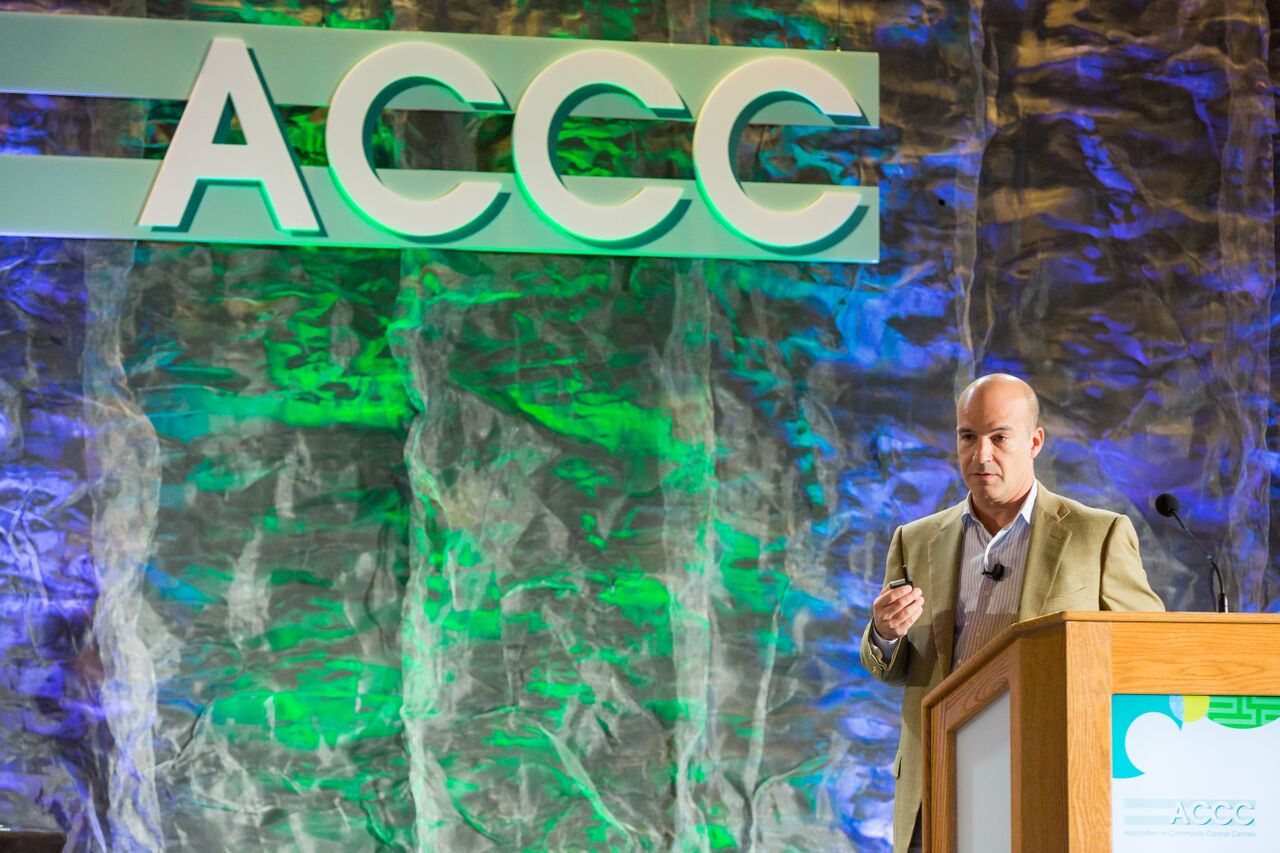
Featured speaker Peter Bach, MD, MAPP, delivers the opening presentation of the ACCC National Oncology Conference.
By Amanda Patton, ACCC, Communications
From the opening presentation by featured speaker Peter Bach, MD, MAPP, to the final sessions focused on cancer survivors and the workplace and providing survivorship services on a shoestring budget—last week’s ACCC National Oncology Conference covered challenges large and small facing cancer programs and practices across the country.
Macro challenges—occurring at the health system and population health level—are well known to the oncology community. Among these are the high cost of cancer drugs and new therapies, the transformative shift in payment from volume to value, workforce shortages, reimbursement constraints, and the many issues tied to ever-increasing demands for data collection and reporting.
Micro challenges—occurring at the service line and individual provider and patient level—range from adapting delivery infrastructures to meet the evolving treatment landscape, to determining metrics to track and how to best to communicate these to leadership, to ensuring patient access to supportive care services that remain unreimbursed, to fostering a holistic, patient-centric culture of care.
Common themes across conference sessions and conversations: Collaboration, integration, evidence-based medicine, and value. Five key takeaways from the conference:
Cancer programs and providers must collaborate outside the box and across the care continuum.
Attendees heard first-hand from programs that are already making this work—from implementing virtual tumor boards, to engaging primary care physicians in survivorship care, to collaborating across disciplines to provide cancer prehabilitation services, and more.
There are formal & informal operational pathways to create integrated delivery networks with stakeholders for quality patient care.
Panelists in the Advancing Quality Care session agreed: to achieve a truly integrated delivery network transparency and trust between all partners is needed.
Oncology programs are increasingly turning to dynamic dashboards to demonstrate value to payers and patients.
Solutions and tools may exist outside the oncology service line. Reach out to the data analytics team or business intelligence team within your organization. Take advantage of or adapt existing resources and tools.
From personalized medicine to immuno-oncology, cancer treatment is undergoing a transformative shift.
For both providers and the patients they serve, the value proposition presented by genomic medicine is that it allows clinicians to make better therapeutic decisions.
Patients are key stakeholders in healthcare integration efforts.
“Successful integration will depend on aligned patient-centered care, patient-focused care, and patient engagement,” said ACCC President Elect Jennie Crews, MD, in the panel discussion on Advancing Quality Care. Panelists touched on the findings included in a new ACCC white paper released at the National Oncology Conference that outlines forward-looking essential steps to ensure quality patient care in the increasingly integrated healthcare environment.
ACCC encourages members to keep the conversation going by sharing your key conference takeaways in our members-only online community ACCCExchange.
Save the date and join us in Washington, D.C., March 2-4 for the ACCC Annual Meeting: CancerScape 2016.
National Oncology Conference: Framing Issues & Finding Answers
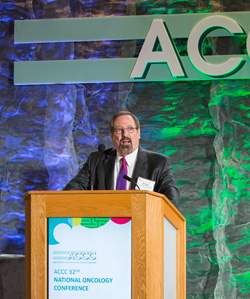
ACCC President Steven D’Amato, BSPharm, BCOP, welcomes attendees to National Oncology Conference
by Amanda Patton, ACCC, Communications
Featured speaker Peter Bach, MD, MAPP, addressed a packed room in the opening session of the ACCC National Oncology Conference on Oct. 22, in Portland, Oregon. Dr. Bach is Director, Center for Health Policy and Outcomes, Memorial Sloan Kettering Cancer Center.
Dr. Bach’s remarks centered on four prime issues challenging oncology today: the cost of cancer drugs, the need for oncology to do a better job on comparative outcomes research, the 340B drug pricing program, and the importance of incorporating end-of-life care into cancer program services.
Finding a rational way to address drug costs matters on both the macro level [in terms of the impact of healthcare costs nationally] and on the micro level at point of care when “drugs are being left at the pharmacy counter because patients can’t afford the copay,” he said.
Conference sessions throughout the day focused on challenges and innovative solutions that can have powerful micro- and macro-level impacts on cancer programs and providers, and the patients they serve: From “how to” sessions on benchmarking salaries, applying lean principles for staffing, establishing a virtual tumor board, distress screening, and preparing for alternative payment models, and more, to a big picture session on Advancing Quality—from Oncology Medical Homes to Integrated Delivery. One cross-cutting takeaway message: work across disciplines and siloes—think about how to collaborate outside the box and across the care continuum.
Stay tuned for more conference highlights. Follow conference on Twitter at #ACCCNOC.
Pre-Conferences Kick Off ACCC National Oncology Conference
by Amanda Patton, ACCC, Communications
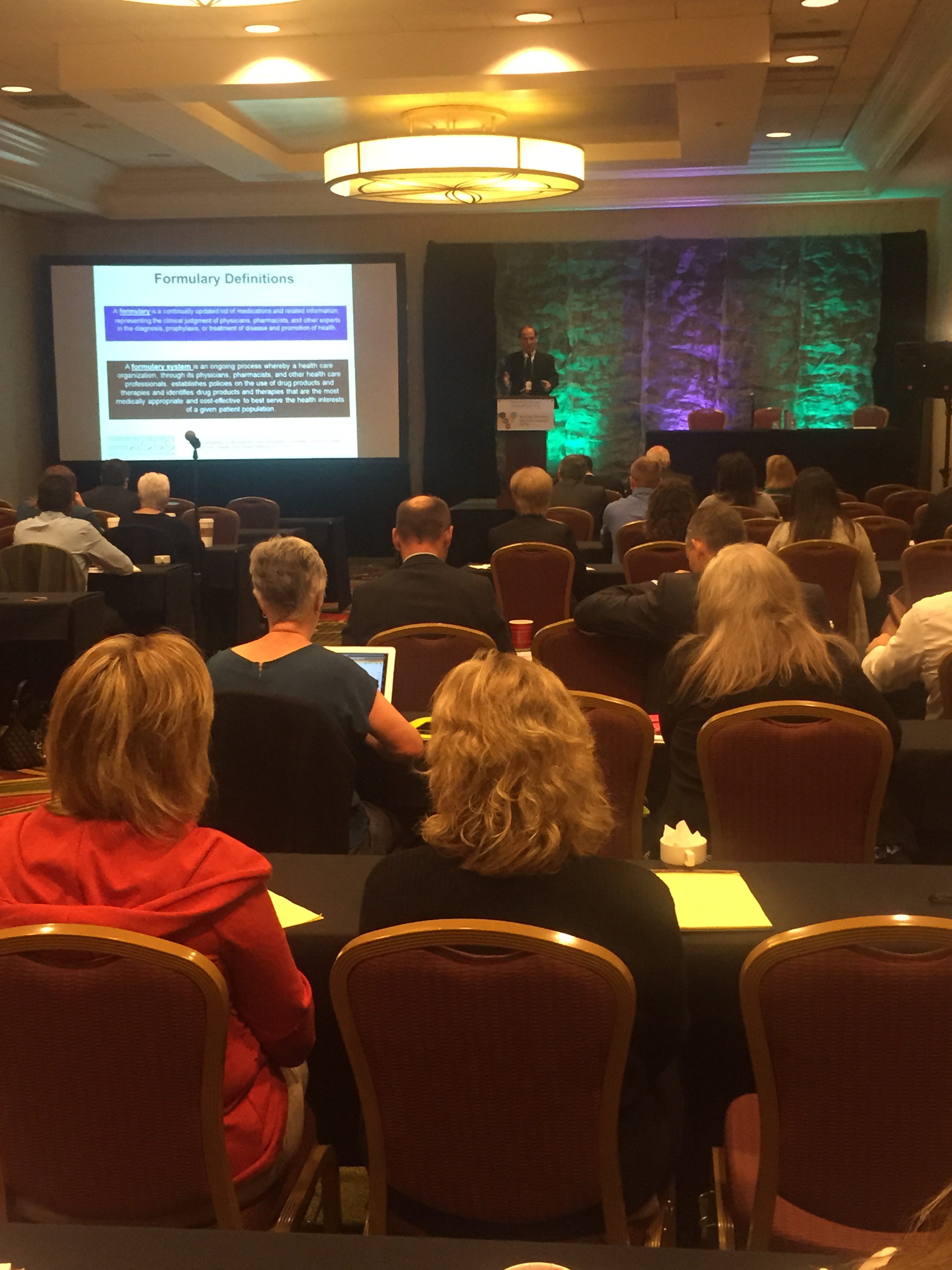
OPEN Pre-Conference attendees listen to session on biosimilars
Cancer care professionals from across the country are gathering in Portland, Oregon, this week for the ACCC 32nd National Oncology Conference.
Yesterday’s pre-conferences set the stage with sessions on oncology pharmacy issues and a program designed for administrators new to oncology.
One hot topic under discussion at the Oncology Pharmacy Education Network (OPEN) pre-conference: Institutional Review of Biosimilars. Jim Koeller, MS, PharmD, of the University of Texas at Austin, told attendees that “nationally, what we hope to create…we’re really trying to get to is a national standard on how biosimilars should be reviewed [by institutions].” Until that time, what can P&T Committees do to be ready for institutional review? Setting up a subcommittee or working group for biosimilars is an important first step, Koeller said.
While biosimilars will be less expensive, they will still be costly and reimbursement for biosimilars will “take a long time to figure out,” Koeller warned.
Key takeaways for oncology pharmacists and the oncology pharmacy:
- Biosimilars are not generics: Use of biosimilars will require clinical review by a multidisciplinary team through the P&T Committee or other mechanism
- A systematic review process will be necessary, looking at product, manufacturing, and institutional factors
- Interchangeability is generally a state issue; keeping up with state laws will be essential.
A common theme across both pre-conferences: Oncology today requires multidisciplinary leadership.
“Almost everything in oncology practice is interdisciplinary,” said presenter John Hennessy, MBA, CMPE, in a New to Oncology session on Leadership and Organizational Structure. To succeed, oncology programs must have processes in place for identifying and training future leaders and aligning incentive across all team members, he said.
Stay tuned for more from the ACCC National Oncology Conference. Follow the conference on Twitter at #ACCCNOC.
 ACCCBuzz
leave a comment